Temperance Tarot Card Meaning
By Blair Andrews · Published July 14, 2017 · Updated May 10, 2026
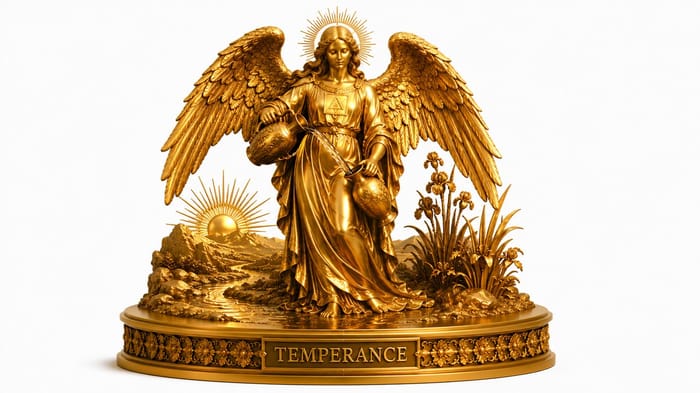
The word "temperance" has been ruined.
Say it today and people picture moderation. A gentle balancing act. Maybe a glass of water instead of wine. The Temperance movement of the 1800s cemented this, and the word became synonymous with restraint, abstinence, saying no to excess.
But that's not what tempering means. And it's not what this card means.
Go to a blacksmith. Watch what happens to steel. The metal is heated until it glows. Then it's hammered: hard, repeatedly, deliberately. Then it's plunged into cold water.
The shock transforms its molecular structure. Then it's heated again. Hammered again. Cooled again. Over and over until the blade holds an edge that won't shatter under pressure.
That's tempering. And that's this card.
If you pulled Temperance today, you're not being told to calm down. You're being told that what you're going through (the heat, the pressure, the sudden cold) is making you into something that can hold an edge.

What the Card Shows You
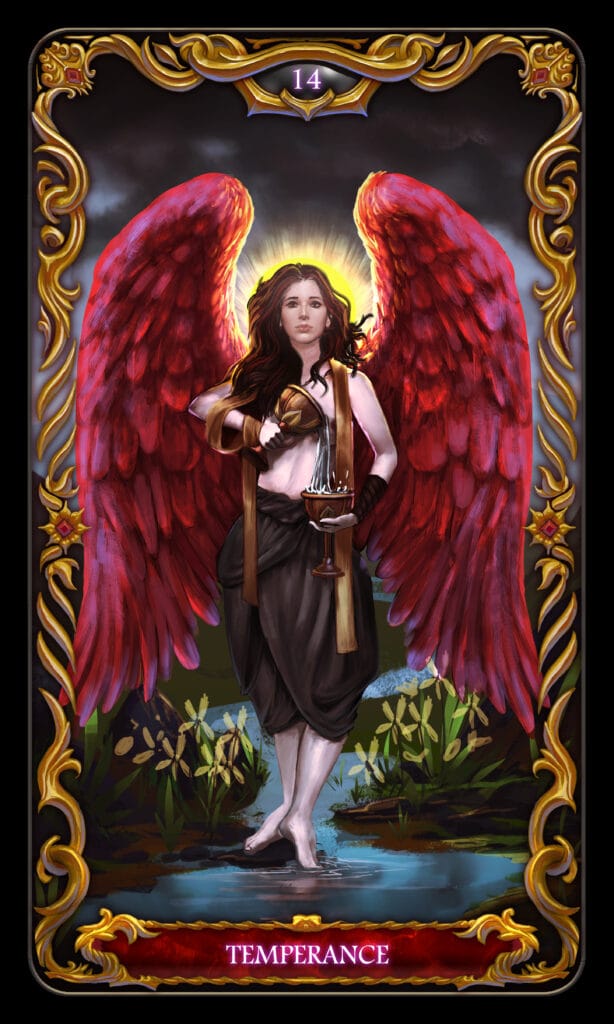
An angel stands with one foot on land and one foot in water. Neither fully grounded nor fully submerged. Testing both. Two cups in hand, pouring liquid back and forth between them in an impossible arc that seems to defy gravity.
A path leads from the water's edge into distant mountains, where something bright (a crown, a light) waits at the horizon. And growing at the edge of the water, iris flowers.
The irises are not decorative. In Greek mythology, Iris was the goddess of the rainbow, the bridge between heaven and earth, the messenger who could walk in both worlds. Her flowers appear in this card because that is exactly what Temperance is doing: bridging.
The rainbow on the angel's path echoes the same idea. Every element in this image points toward the same truth: that the work of this card is connection between realms that seem separate.
The angel is Michael, neither male nor female. This matters. Temperance isn't operating from the masculine or the feminine, the rational or the intuitive. It's working from a place that has integrated both.
The mixing of the two cups is the mixing of these energies, and the angel's stance (one foot in each world) is the proof that the integration is happening through direct experience, not theory.

One Foot In the Water
That foot in the water deserves more attention than it usually gets.
One foot on solid ground, one in the water. This is not mystical passivity. It is testing. Verification. The act of proving what you've realized inwardly by bringing it into contact with outer experience.
Inner realization means nothing until you check it against reality. You can sit in meditation and feel profound certainty about who you are and what you're meant to do - but that certainty is untested until you stand up and walk into the world with it.
The angel doesn't float above the water. The angel doesn't stand entirely on dry land either. The angel puts one foot in and finds out what's real.
That's why the path leads forward from this position - not from the land alone, not from the water alone, but from the place where both meet. The crown at the horizon isn't reached by choosing one world over the other. It's reached by standing in both at once and letting the contact between them reveal what's true.

The Number Behind the Number
Temperance is Key 14. In numerology, 14 reduces to 5 (1 + 4 = 5). Five is the Hierophant's number - the inner teacher, the bridge between worlds, the capacity to hear your own wisdom.
This reduction isn't coincidence but architecture.
The Hierophant (Key 5) teaches you that interior guidance exists. Temperance (Key 14) is what happens when you test that guidance against lived experience. Five gives you the insight. Fourteen forges it into something durable.
The inner knowing has to survive contact with reality (the heat, the hammer, the cold water) before it becomes actual wisdom you can use.
That's the relationship between hearing your inner voice and trusting it. The Hierophant hears. Temperance verifies.

Karmic Debt 14: The Debt This Card Repays
Here is something that connects the tarot and numerological traditions in a way that is rarely discussed.
In numerology, 14 is a Karmic Debt number. The 14/5 debt represents the misuse of personal freedom, typically in a past cycle or earlier phase of life.
It manifests as overindulgence in sensory experience, the refusal to commit, the habit of chasing the next thrill instead of building something lasting. People carrying 14/5 energy often feel restless, scattered, pulled toward excess.
Temperance, as Key 14, is the antidote to exactly this pattern.
The card doesn't preach abstinence. It doesn't tell you to stop wanting things. Instead, it shows you what happens when the raw appetite for experience (the 14) is submitted to the forging process.
The heat and the hammer don't destroy desire. They refine it. They turn the scattered craving for more-more-more into the focused ability to alchemize experience into wisdom.
If Karmic Debt 14 is the wound, Temperance is the surgery. Painful, precise, and ultimately healing, but only if you stay on the table.

The Serpent That Swallowed Its Tail
Every Major Arcana card has a Hebrew letter. Temperance's letter is Samekh, which is traditionally depicted as a serpent biting its own tail - the ouroboros, the complete circle.
This completes a sequence that runs through three cards. In Key 8 (Strength), the Hebrew letter Teth represents the serpent coiled: raw life force, potential energy, the power before it moves.
In Key 11 (Justice), the letter Lamed is the serpent uncoiled and active, half-extended, the ox-goad, the directing force, energy in motion but not yet at its destination.
Now in Key 14, Samekh: the serpent's head reaches its own tail. The circuit is complete.
The energy that was coiled in Strength and directed in Justice has come full circle. Control isn't something you impose on life force from the outside. It's what happens when the energy completes its natural cycle - when the beginning and the end find each other.
You've been through something. The tempering process started cards ago. Temperance says: the circle is closing. What you started is finding its way back to you, transformed.

Upright: The Forge Is Working
When Temperance appears upright, you're in the middle of being made into something. It doesn't always feel graceful. The mixing of opposites (the hot and the cold, the spiritual and the practical, what you want and what is) can feel like being pulled in two directions at once.
That tension is the point.
Temperance upright asks you to stay in the process. Don't flee the heat. Don't avoid the cold plunge. The path in the card leads somewhere specific - toward that distant crown on the horizon, but you only get there by enduring the back-and-forth.
The pouring between the two cups isn't indecision. It's refinement. Each pass removes something that doesn't belong.
In practical terms: you're being asked to hold two things that seem contradictory and let them teach each other. The relationship that needs both honesty and patience.
The career that demands both ambition and surrender. The inner life that requires both discipline and softness. Temperance says these aren't opposites. They're ingredients. And you are the vessel where they combine.
This card often appears during transitions, not the dramatic, everything-shatters kind, but the slow ones. The months after a decision where you're living with the consequences and they haven't fully resolved yet.
The period when the new job still feels foreign, the new relationship hasn't settled into its rhythm, the new way of seeing yourself hasn't quite solidified. Temperance says: stay. The forging isn't done. What feels unfinished is actually in process.

Reversed: Refusing the Forge
Reversed, Temperance often means you've stepped out of the forge. You've either fled the heat (avoiding the difficult experience that was actually shaping you) or you've refused the cooling, staying in the intensity past the point of usefulness. Either way, the tempering process has stalled.
Sometimes this looks like impatience. You want the finished blade without the repeated cycles of heating and hammering. You want the wisdom without the testing. The reversed card says: there are no shortcuts through this. The metal that skips the tempering looks fine until it meets real pressure. Then it shatters.
Other times, the reversal points toward spiritual bypassing - using inner experience as a substitute for outer engagement. You've had the realization, the insight, the moment of clarity. But you haven't brought it into contact with the ground.
One foot is still in the water. The other has never touched the earth. Unverified spiritual experience remains just imagination with good lighting. Temperance reversed asks: where are you refusing to test what you believe?
And there's a warning embedded in this card's position in the sequence. The very next card, Key 15, is the Devil - the card of self-imposed bondage, of mistaking illusion for reality. Temperance reversed is a preview of that trap.
If you refuse the forging - if you won't do the difficult work of integrating your inner and outer lives - you become vulnerable to the chains you could have avoided. The Devil doesn't capture you by force. The Devil captures people who skipped Temperance.

Sagittarius and the Aim
Temperance is assigned to Sagittarius - the archer. And Sagittarius is about aim. Not just ambition or optimism, though the popular readings love those words. Aim. The act of choosing a target, drawing the bow, and releasing with precision.
But an arrow that hasn't been properly made - its shaft not straight, its point not tempered - will never fly true no matter how skilled the archer. The tempering comes first.
The aim comes after. Sagittarius energy wants to launch, to explore, to fire into the distance. Temperance says: not yet. First, become the arrow that can actually reach the target.
The card's dominant color is blue - the color of the subconscious, of water, of the High Priestess, and this is another clue. The work of Temperance isn't happening on the surface. It's deep.
The molecular structure of the metal changes during tempering in ways invisible to the eye. You might not be able to see what's shifting in you. That doesn't mean nothing is happening.
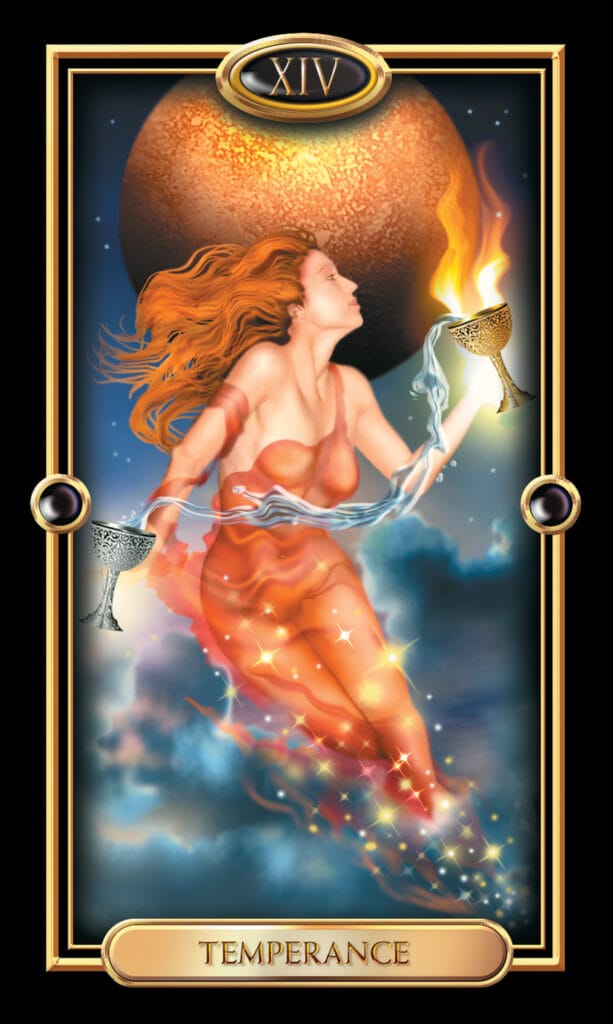
The Gilded Tarot Deck by Ciro Marchetti © 2004 Llewellyn Worldwide, Ltd. All rights reserved, used by permission.

The Seven-Pointed Star
On the angel's chest (or in some depictions, on the garment near the heart) is a seven-pointed star. The heptagram. Seven points, evenly spaced.
Here's what makes this symbol remarkable: you cannot draw a regular seven-pointed star freehand. You can sketch a five-pointed star without lifting your pen.
A six-pointed star is two overlapping triangles - simple geometry. But seven points, evenly distributed around a circle? That requires a compass. It requires experimentation. Measuring, adjusting, trying again.
A seven-pointed star never occurs spontaneously in nature. No crystal grows into this shape. No flower has seven identical petals. It exists only because someone deliberately created it through repeated, patient effort.
That's the final teaching of Temperance, and it's the one that separates this tradition from the shallow version. The great work - whatever that means for you, the becoming of who you actually are - cannot be completed by nature alone.
The universe will not do it for you. Life will bring the heat and the cold, the challenges and the respites. But the forging requires your active participation. Your hands on the compass. Your willingness to try, measure, adjust, and try again.
The seven-pointed star can't draw itself. And neither can you be tempered without choosing to stay in the fire.

Frequently Asked Questions
What does the Temperance card mean in a love reading?
In a love reading, Temperance indicates a relationship that is being refined through the process of integrating two different people, two different needs, two different histories. It asks for patience with the back-and-forth - the mixing of the cups - rather than forcing a resolution.
Reversed, it can suggest that one or both partners are avoiding the deeper work the relationship requires, or that impatience is sabotaging something that needs more time in the forge.
What is the connection between Temperance and Karmic Debt 14?
In numerology, 14 is a Karmic Debt number representing the past misuse of personal freedom - excess, restlessness, and the refusal to commit. Temperance, as Key 14 of the Major Arcana, functions as the remedy for this debt.
The card's process of forging and refinement transforms scattered desire into focused wisdom. It doesn't eliminate the appetite for experience; it tempers it into something that can hold an edge.
Why does Temperance come right before the Devil card?
The sequence is deliberate. Temperance (Key 14) represents the integration of inner and outer experience - the forging that makes you strong enough to face illusion without being captured by it. The Devil (Key 15) represents self-imposed bondage, mistaking appearances for reality.
If you skip the work of Temperance - if you refuse the forge - you arrive at the Devil without the tempered awareness needed to see through its traps. Temperance is preparation; the Devil is the test.
What does the Hebrew letter Samekh tell us about Temperance?
Samekh is depicted as a serpent biting its own tail - the ouroboros. It completes a three-card serpent sequence: Teth (Strength, Key 8) shows the serpent coiled as potential energy; Lamed (Justice, Key 11) shows the serpent half-extended and in motion; Samekh (Temperance, Key 14) shows the serpent completing the circuit.
The energy that was stored, then directed, has come full circle. What you set in motion is returning to you, transformed.
Other Major Arcana Cards
The Fool • The Magician • The High Priestess • The Empress • The Emperor • The Hierophant • The Lovers • The Chariot • Strength • The Hermit • Wheel of Fortune • Justice • The Hanged Man • Death • Temperance • The Devil • The Tower • The Star • The Moon • The Sun • Judgement • The World