The Hanged Man Tarot Card Meaning
By Blair Andrews · Published July 14, 2017 · Updated May 21, 2026
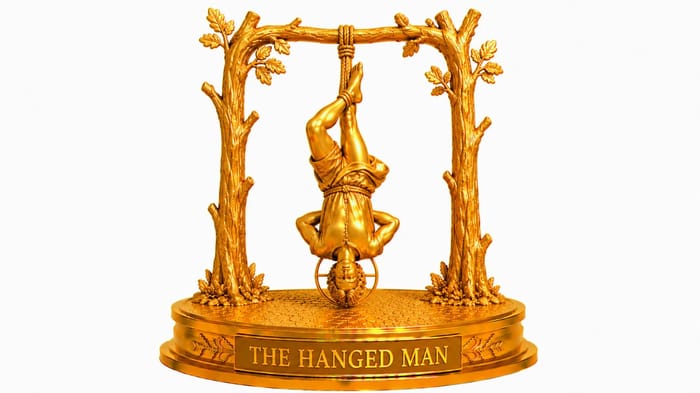
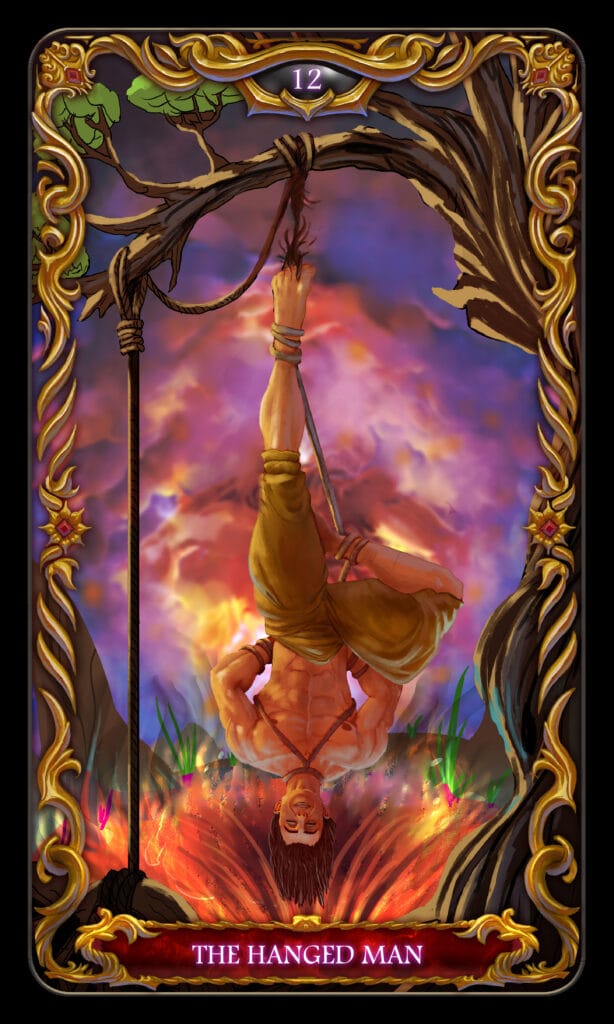

The Hanged Man - Key 12
Look at his face. That's the first thing that doesn't add up.
A man hangs upside down from a wooden crossbar, one leg bent behind the other, arms tucked behind his back. By every rule of common sense, this should be a scene of suffering. Captivity. Consequence.
And for centuries, that's exactly how people read it: punishment, martyrdom, a life suspended against its will.
But his face is calm. More than calm. It's glowing.
If you just pulled The Hanged Man and your stomach dropped, stay here for a minute. This card is not what it looks like. Almost nothing about it is.
What it actually means when it shows up
The Hanged Man is a voluntary stop. Not forced. Chosen. Something in your life is asking you to stop pushing, stop solving, stop trying to make things happen through sheer effort. Not because you've failed, but because the kind of understanding you need right now doesn't come from effort.
You've probably had the experience. A problem you've been grinding on for weeks, and the answer arrives in the shower, on a walk, in the half-second before sleep, the moment you finally stopped trying. The Hanged Man is that moment made into a card.
Upright, this card says: you're being asked to let something go. A viewpoint. A need for control. A certainty that you're seeing the situation correctly. The suspension isn't the problem. The suspension is how the solution arrives.
He's not being punished - he jumped
This is the correction that unlocks the entire card. The Hanged Man was never dragged to the gallows. Look at his body language. His hands are behind his back, not bound but deliberately placed there. The posture says, plainly: not my doing.
This is someone who chose to stop acting.
His head glows with a halo of golden light. In the esoteric tradition, that radiance appears precisely because personality has stepped aside.
When you stop running the show - stop managing, stop strategizing, stop insisting you know how this has to go - something higher fills the space you vacate. The glow isn't a reward. It's what naturally occurs when the ego gets quiet.
The old title of this card wasn't "The Hanged Man" the way we hear it. It meant something closer to "The Suspended Mind." Manas - the Sanskrit root of "man" - means mind. This is a card about suspending the mind's usual habits. Not destroying thought, but pausing the particular kind of thinking that keeps you stuck.
Water reflects everything upside down
The Hebrew letter assigned to this card is Mem, which means "water." The assignment is not decorative symbolism. It's the key to the whole thing.
Water shows you the world in reverse. Trees point downward. The sky sits below your feet. Everything you thought was solid and fixed becomes fluid and inverted. The Hanged Man lives in that reversal.
He sees what you see, but from the opposite orientation - and from there, what looked like a wall reveals itself as a door. What felt like loss starts to look like release.
This is sometimes called the Law of Reversal. Not a mystical abstraction but a practical observation. The approaches that aren't working are often exact inversions of the approach that will.
You've been pushing; the answer is in yielding. You've been speaking; the answer is in listening. You've been holding on; the answer is in opening your hands.
When this card appears, ask yourself: what if the opposite of what I'm doing is what's needed?
The geometry no one mentions
Look at the Hanged Man's body more carefully. His bent leg crosses behind his straight leg, forming the shape of an inverted 4. His arms, tucked behind him, and his head together form a triangle - the shape of 3.
Four is the number of reason, measurement, structure, the Emperor's energy. Three is imagination, creative growth, the Empress. In the Hanged Man's body, the triangle sits beneath the four. Imagination subordinated to reason.
This is quietly radical. Most people let imagination run unchecked - fantasies of catastrophe, projections of failure, stories about what other people are thinking. Reason gets dragged along behind whatever the imagination invents.
The Hanged Man reverses that arrangement. Reason determines what mental images occupy the mind. Imagination serves the architecture, not the other way around.
The word for it is mastery, not suppression. And it happens not through force but through the willingness to stop and let things reorder themselves.
Reversed: when you won't let go
The Hanged Man reversed is usually about resistance. You know something needs to change - a perspective, a pattern, a grip you have on how things "should" be - and you're refusing.
Sometimes it's fear. If I let go of this belief, this relationship, this version of myself, what's left? The reversed Hanged Man understands that fear. But it also says the suspension you're avoiding is coming whether you choose it or not. Voluntary surrender is gentler than involuntary collapse.
Other times, the reversal points to stalling disguised as patience. You tell yourself you're waiting for the right moment, but really you're just not moving.
The Hanged Man's stillness is active, like a spinning top that appears motionless precisely because it's moving with such intensity. If your stillness feels dead rather than alive, something has gotten stuck. The card reversed asks: are you surrendering, or are you hiding?
There's also a simpler reading. Sometimes reversed, the Hanged Man just means you've been hung up on something too long. A grudge, a regret, an old story about yourself that stopped being true years ago. Cut the rope. The ground is closer than you think.
The gallows and the world
There's a detail worth pausing on. The wooden frame the Hanged Man hangs from - the T-shaped crossbar - is shaped like the Hebrew letter Tav. Tav is assigned to Key 21, The World. The final card of the Major Arcana.
The Hanged Man is literally suspended from the World.
The implication is precise: the framework supporting this entire experience of surrender is the completed journey itself. The destination holds you while you learn to let go.
You're not falling into nothing. You're held by everything.
The two upright posts on either side of the crossbar each have six lopped branches - twelve in total. Twelve signs of the zodiac. The entire wheel of cosmic time forming the structure of this single, still moment. The universe isn't watching him hang there. It's the scaffold.
Neptune's depth, and the number that creates
The Hanged Man belongs to Neptune - the planet of dissolution, dreams, and the erasure of boundaries. Neptune doesn't build.
It dissolves the walls between things so you can see that they were never separate. Under Neptune's influence, certainty softens. Categories blur. The rigid distinctions your mind relies on to feel safe become transparent, and through them you catch something wider.
This is why the card's color is blue - the blue of deep water, of the subconscious, of the High Priestess's robe. It's the color of reception. Of letting impressions arrive rather than going out to hunt for them.
The card's number, 12, reduces to 3 (1 + 2). Three is the Empress - creation, fertility, the multiplication of what's been seeded. Here's the paradox the Hanged Man carries: sacrifice produces creation. Letting go of control is the act that allows something new to be born.
You give up the old perspective, and from that emptiness, a richer understanding grows. The Empress hidden inside the Hanged Man. Stillness that's secretly generative.
The Fool, inverted
One more layer, and it might be the most important.
There's an old esoteric observation that the Hanged Man is the Fool turned upside down. Key 0 leaps into the unknown, all forward motion, all trust, all beginning. Key 12 is that same energy - paused. The Fool acting as a pendulum, but not swinging. Perfect stillness at the center of what could be motion.
The Fool doesn't know what will happen. The Hanged Man has stopped needing to know. Both reach the same place - trust in something beyond personal control - but by opposite routes. One through fearless motion, the other through fearless stillness.
This is why the Hanged Man's face glows. Not because he's being rewarded for suffering. Because he's arrived at the same place the Fool starts from, but this time with full awareness. The innocence isn't naive anymore. It's earned.
There's a line from the contemplative tradition that belongs here: the mind in this state is still the way a spinning top is still - so fast it appears motionless. Alive, moving with such completeness that the movement becomes invisible.
That's the Hanged Man. Neither punishment nor passivity, but the living stillness at the center of the turn.
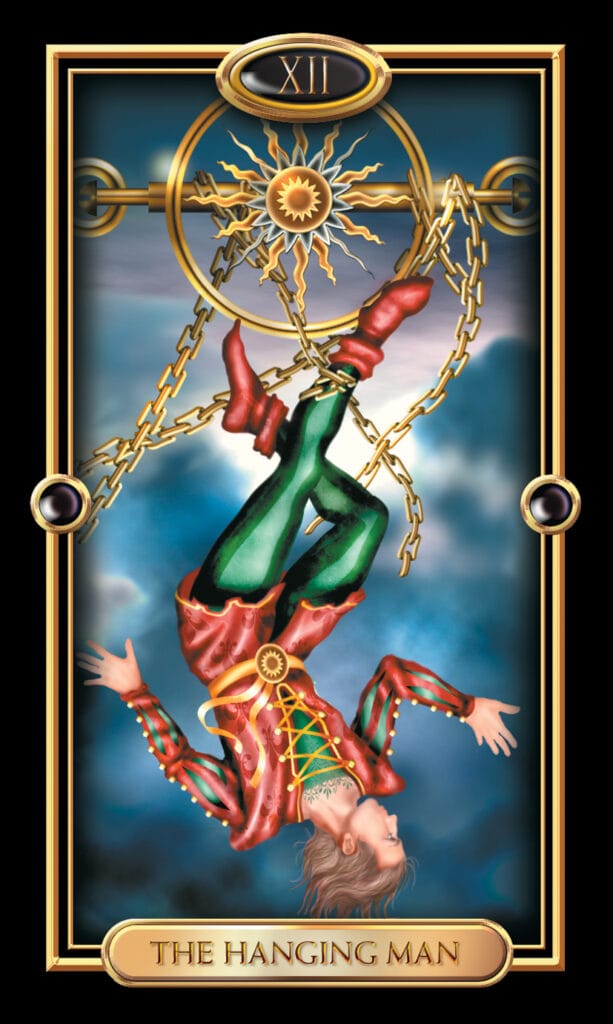
The Gilded Tarot Deck by Ciro Marchetti © 2004 Llewellyn Worldwide, Ltd. All rights reserved, used by permission.

Questions
What does the Hanged Man mean in a tarot reading?
It means something in your life is asking you to stop pushing and let things reorder themselves. Not because you have failed, but because the kind of understanding you need right now does not come from effort.
The Hanged Man is the moment the answer arrives in the shower or on a walk - the moment you finally stopped trying. The suspension is not the problem. The suspension is how the solution arrives.
Is the Hanged Man a bad card?
No. It looks alarming, a man hanging upside down, but look at his face. It is calm. Glowing. This is one of the most transformative cards in the Major Arcana.
The number 12 reduces to 3 (the Empress), which means sacrifice produces creation. Letting go of your grip on how things “should” be is the act that allows something new and better to be born. The stillness is secretly generative.
What does the Hanged Man reversed mean?
Usually resistance. You know something needs to change - a perspective, a pattern, a grip you have on how things should be - and you are refusing. Sometimes it is fear: if I let go, what is left?
The card says the surrender you are avoiding is coming whether you choose it or not. Other times the reversal means you have been hung up on something too long - a grudge, a regret, an old story. Cut the rope. The ground is closer than you think.
What is the connection between the Hanged Man and the Fool?
The Hanged Man is the Fool turned upside down. Key 0 leaps into the unknown with fearless motion. Key 12 reaches the same place - trust in something beyond personal control - through fearless stillness.
The Fool does not know what will happen. The Hanged Man has stopped needing to know. Both arrive at trust, but by opposite routes. That is why his face glows: the innocence is no longer naive. It is earned.
Other Major Arcana Cards
The Fool • The Magician • The High Priestess • The Empress • The Emperor • The Hierophant • The Lovers • The Chariot • Strength • The Hermit • Wheel of Fortune • Justice • The Hanged Man • Death • Temperance • The Devil • The Tower • The Star • The Moon • The Sun • Judgement • The World