13 Occult Numbers and Their Dark, Hidden Meanings
By Blair Andrews · Published October 6, 2020 · Updated May 10, 2026
What Makes a Number "Occult"?
The word "occult" simply means hidden - beneath the surface, requiring effort to see. It carries no inherent connotation of evil, danger, or allegiance to any particular tradition.
Certain numbers have accumulated thick layers of superstition, fear, and folklore over the centuries. Some of that reputation is earned. Much of it is not.
The numbers that tend to attract the most intense reactions (13, 666, 7, 11, and a handful of others) carry real historical weight, but their actual stories are often far more interesting than the simplified versions that survived into popular culture.
What follows is not a list of numbers to fear or avoid. It is a look at what several of the most notorious numbers actually meant in the traditions that first made them significant, and why those meanings shifted over time.

The Number 13: What Steps Beyond the Circle
In the older systems of number symbolism, 12 was the number of cosmic completion. Twelve zodiac signs. Twelve months. Twelve hours of day and twelve of night. Twelve tribes, twelve apostles, twelve labors. The number 12 built a complete circle, a finished system where everything had its place.
13 was the number that stepped past that circle.
This made it powerful and unsettling in roughly equal measure. It was not a number of destruction. It was a number of disruption. Whatever had been neatly arranged in twelves, 13 pushed beyond.
In older goddess-centered traditions, 13 was linked to the lunar calendar: there are approximately 13 lunar months in a solar year, which meant the moon did not fit the tidy twelve-month solar framework. It overflowed it.
The gradual demonization of 13 has less to do with anything inherently wrong with the number and more to do with which calendars won the cultural argument.
When solar-based religious calendars displaced lunar ones, the "extra" month became suspect. The number associated with it inherited that suspicion.
In older occult systems, 13 was understood as death-and-renewal, the number of threshold crossing. Not an ending, but the uncomfortable passage between one completed cycle and whatever comes next.
The tarot's Death card, numbered 13, carries exactly this meaning: not physical death, but the stripping away of what has served its purpose to make room for what has not yet arrived.
Fear of 13 is real enough that buildings skip the thirteenth floor and airlines skip row thirteen. But the fear is cultural, not mathematical. The number itself simply marks the point where the familiar system ends and the unmapped territory begins.

666: The Sun's Overwhelming Brilliance
No number in Western culture carries more baggage than 666. Its association with ultimate evil is so deeply embedded that most people never question it. But the actual origin of this number tells a very different story. Two stories, in fact, layered on top of each other.
The first is political. In Hebrew gematria (the system of assigning numerical values to letters) the name "Nron Qsr" (a Hebrew transliteration of Nero Caesar) adds up to exactly 666.
When the text that would later be called the Book of Revelation circulated among early communities living under Roman persecution, 666 was almost certainly a coded reference to the emperor. A way to name the oppressor without naming him directly. Political satire disguised as prophecy, written by people who had very practical reasons to use code.
The second story is older. In the system of planetary magic squares attributed to the Renaissance scholar Agrippa (who was drawing on much earlier sources) each of the seven classical planets had a corresponding magic square.
The Sun's square was a 6-by-6 grid. When you add every number in that grid, the total is 666.
This made 666 the sum of all solar power. Not evil but excessive. Blinding. The full, unfiltered force of the sun concentrated into a single value.
In esoteric tradition, this is a number of overwhelming brilliance rather than darkness, light so intense it becomes destructive, like staring directly at the sun itself.
The journey from "coded political criticism" and "solar excess" to "number of ultimate evil" happened gradually, over centuries of reinterpretation.
Each generation read the inherited symbol through its own anxieties and added another layer of fear to what began as something far more specific and far more human.

The Number 7: What Cannot Be Perfectly Built
Seven shows up everywhere. Seven days of the week, seven notes in the musical scale, seven classical planets visible to the naked eye, seven colors in the rainbow. Its presence in so many natural and cultural systems has made it one of the most symbolically loaded numbers in human history.
But the reason 7 held such a singular position in the older traditions of number symbolism is more specific than simple frequency. It comes from geometry.
A regular heptagon (a seven-sided figure) exists in theory but cannot be constructed perfectly using only a compass and straightedge. Every other polygon with fewer than seven sides can be.
The triangle, square, pentagon, and hexagon all submit to the basic tools of geometry. The heptagon resists. It can be approximated but never made exact by purely physical means.
For the ancient schools that treated geometry as a window into cosmic order, this was deeply significant. It meant that 7 existed beyond the reach of material perfection.
It could be known intellectually but not captured physically. It belonged to the realm of spirit rather than the realm of matter.
This is why 7 became the number of the sacred, the contemplative, and the inward-turning. In numerology's Life Path system, the 7 path is one of seeking, questioning, and solitary understanding. The number's ancient geometric property (present but uncapturable) still echoes in how we interpret it thousands of years later.

The Number 11: Excess or Inspiration
In the classical number systems, 1 through 10 formed a complete set. The Pythagorean tradition regarded the first ten numbers as containing everything: all ratios, all proportions, all the relationships that structured reality. The decade was sacred.
11 was the number that overstepped it.
In the older sources, this was not a compliment. Transgression, excess, instability. These were the qualities associated with 11.
It pushed past the boundary of the completed system without establishing a new one. It was neither the fulfillment of 10 nor the fresh beginning of the next cycle. It occupied a genuinely uncomfortable middle ground.
Modern numerology reversed this interpretation almost completely, designating 11 as a "Master Number" carrying heightened spiritual potential. The reasoning was that the doubled 1, two pillars side by side - represented a gateway to higher awareness.
Both readings capture something real. Whether the energy of 11 manifests as inspiration or instability depends largely on the individual carrying it.
The older tradition was not wrong that 11 carries tension and volatility. The modern tradition is not wrong that tension and volatility can become fuel for genuine insight. The number itself is neutral. What the person does with its intensity is not.
For a deeper look at how Master Numbers function in a personal chart, the key question is always whether the heightened frequency is being channeled or simply endured.

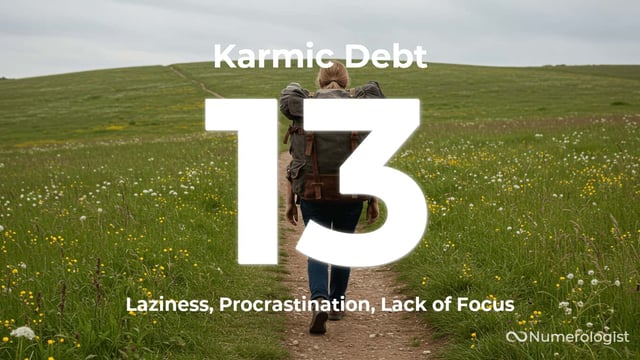
The Karmic Debt Numbers: 13, 14, 16, 19
These four compound numbers occupy a specific position in the Pythagorean numerology system. They appear when a core number - your Life Path, Expression, Soul Urge, or Birthday - reduces to its single digit through one of these intermediate values.
A Life Path that reduces to 5 through the intermediate step of 14 carries a different weight than one that reaches 5 through, say, 23. The final digit is the same. The path to it is not.
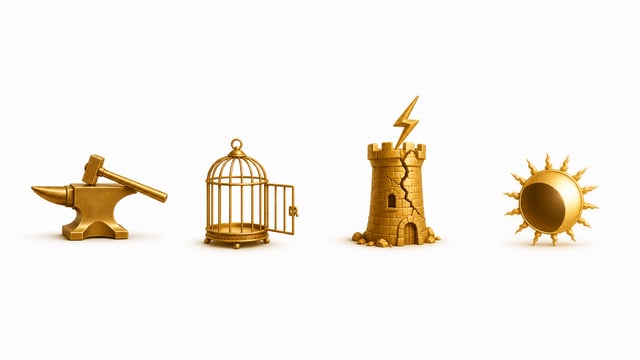
13/4 describes the challenge of discipline through resistance. The work is real and the demands are heavy. Old traditions associated it with death and rebirth - not as punishment, but as the requirement that something be broken down completely before it can be rebuilt correctly. The number demands effort but rewards persistence with structures that genuinely hold.
14/5 describes the challenge of freedom through consequence. Where a plain 5 seeks variety and experience, the 14/5 has to learn that not every door should be opened just because it can be.
Previous misuse of freedom created a debt; the current expression of that number requires learning to choose wisely rather than choosing constantly.
16/7 describes the challenge of spiritual honesty. The ego must be confronted directly. Old traditions described this as "the shattered tower" - a structure of false identity that must collapse before genuine understanding can be built.
It is the most psychologically intense of the four Karmic Debts, and it tends to produce pivotal moments where self-image and reality collide.
19/1 describes the challenge of independence through interdependence. The natural 1 energy wants to stand alone, but the 19 version of it must learn that genuine independence includes the capacity to ask for help and accept it. Self-reliance achieved through isolation is not mastery; it is avoidance.

The Number 3: Creation and Its Shadow
Three is often treated as purely lucky - third time's the charm, the power of the trinity, three wishes from the genie. And there is real substance behind that reputation.
Three represents the point at which a pattern becomes visible. One is a point. Two is a line. Three is a shape - the first geometry, the first stable form.
But folklore also preserves a less comfortable side of 3. Bad things come in threes. Three knocks at the door with no one there. The third son who succeeds where the first two fail - which means the first two had to fail.
Three carries the energy of creation, and creation is not always gentle. It requires that something new displace something old.
In numerology, the 3 vibration is fundamentally about expression - getting the internal external, giving form to what was previously formless. The shadow side of that process is the vulnerability that comes with it. To express is to be seen. To be seen is to be exposed. The number's cheerful reputation masks a genuine courage requirement.

Numbers as Mirrors, Not Monsters
The common thread running through all of these so-called occult numbers is that none of them are inherently dangerous. They are mirrors. They reflect the anxieties of whoever is looking at them.
13 terrifies people who need their systems complete and predictable. 666 terrifies people who have been taught that power itself is evil. 7 fascinates people who sense something beyond the material. 11 either electrifies or destabilizes, depending on the person's capacity for intensity.
The traditions that first gave these numbers their reputations were not afraid of them. They were trying to understand them - to map the places where human experience becomes difficult, uncomfortable, or simply strange.
The fear came later, when the maps were separated from the understanding that produced them.
If a number unsettles you, that is probably worth paying attention to. Not because the number is doing something to you, but because your reaction to it may be pointing at something you have not yet looked at directly.
That is what "occult" actually means - hidden - and the hidden thing is almost always inside the person, not inside the number.

Frequently Asked Questions
Is the number 13 actually unlucky?
Not inherently. The superstition around 13 comes from its position as the number that breaks the completeness of 12. In older lunar traditions, 13 was simply the count of full moons in a year - a natural cycle, not a curse. Its "unlucky" reputation developed gradually as solar calendars and twelve-based systems became dominant. The number itself is neutral; the cultural anxiety around it is not.
Should I be worried if 666 appears in my numerology chart?
No. The number 666 does not appear as a standard result in Pythagorean numerology calculations, which reduce to single digits or Master Numbers. If you encounter it elsewhere - an address, a phone number, a transaction amount - it carries no numerological weight in your personal chart. Its fearsome reputation is a product of specific historical and religious contexts, not a universal warning.
What is the difference between a Karmic Debt number and a regular compound number?
Only four compound numbers are designated as Karmic Debts: 13, 14, 16, and 19. Other compound numbers (like 23 or 25) add texture to their reduced digit but do not carry the same implication of unresolved lessons from prior cycles. Karmic Debt numbers suggest that the energy of the reduced digit comes with specific challenges that must be addressed before it can be expressed cleanly.
Why do some cultures fear different numbers than others?
Because number superstition is almost always rooted in language. In Mandarin, 4 sounds like the word for death. In Japanese, 9 sounds like the word for suffering. In Italian, 17 can be rearranged to spell a Latin phrase meaning "my life is over." These associations are linguistic accidents that became cultural beliefs - powerful precisely because they are reinforced by daily speech. The numbers themselves are not doing anything different from country to country. The words are.